Presumed credibility often applies to not for profit organisation as we, as consumers, assume they are credible because they aren’t earning a ‘profit’ from funds given. A good example of an Australian not for profit, and legitimate one, is the Movemeber Foundation who focus on donating funds to help prevent men’s suicide and also men’s health in general.
Reputable credibility is the idea that a source is more reliable if it shows it has won awards for the services it offers. Another thing that gives reputible credibility is if the website is linked to by a credible one, so for example if i go to the partners of Movemeber Foundation I will be linked to something I’ve never heard of before called Stomping Ground Brewing Co., but i believe it is credible because i got linked there by the Movember Foundation.
Surface credibility is all about how a site looks. If a site looks more professionally designed then consumers are automatically more inclined to trust it over those with major spelling errors and shady looking links. This is all surface credibility. A good example of a site with fantastic surface credibility is the City of Wanneroo homepage, it gets updated regularly and has impeccable design.
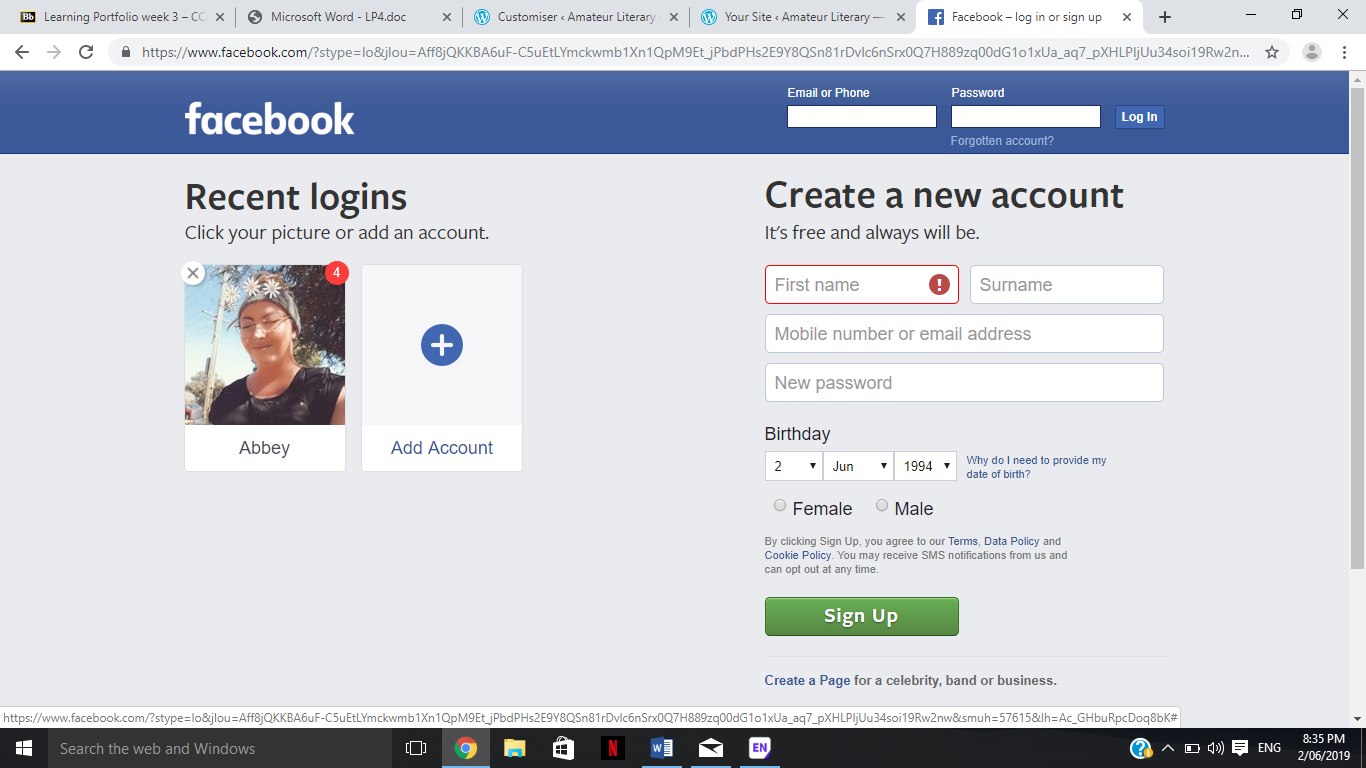
To sum it up, earned credibility is the ease of use, aesthetic design and intelligence of the site. So site’s that look great, are easy to use, recognised you’ve been on them before, respond to any questions in a timely matter and they just simply make sense. It is the hardest level of credibility to achieve as all the things that contribute take time, by both the site and the consumer. An example of earned credibility is social media sites, because they are so commonly used. So Facebook is a great example of widespread earned credibility.
Q1) The author of this week’s article (Fogg) discussed credibility as a key attribute to evaluate online resources. In your own words, describe why it is important that we evaluate credibility of websites. In your discussion, provide an example of how credibility of the Web resources could affect you as a student.
As a students we have to analyse and evaluate the credibility of our sources to ensure the credibility of ourselves is not compromised. In writing academic texts we must have a thesis and evaluate this thesis by providing a solid argument with credible sources. If we use non-credible sources it means the reader or evaluator of own work will discredit the information we have as false as the sources we have gained our information from are not considered genuine. Metzger analyses the different types of credibility and the importance of using only credible sources for vital information in academic texts. Specifically Metzger focuses on Digital Media and Youth and the credibility of sources and the implications of the questionable sources especially in the digital media platforms. The text also gives readers the ability to identify and understand if a source is credible, even if they appear to be legitimate, and how to evaluate this.
Q2) In the learning portfolio, Wikipedia is not accepted as a credible resource for academic assignments. What do you think is the reason Wikipedia is not accepted.
As stated previously, if students use untrustworthy sites their own work may be discredited and ‘marked down’. When those sites are listed in our references, our work also becomes unreliable and no longer credible and overall, this is benefiting no one. Wikipedia is one of the most untrustworthy sites to use, which is why it is not allowed. This is because wikipedia has the ability to be altered by anyone, anytime. So for example if someone feels like adding in some definitely false information, they can and it is live, immediately. See Below:
As you can see, literally any information can be inputted and accepted – unless reported and followed up by the administrative team. Even though it’s still sometimes too late – as we can see for Kathleen Genevieve Ledecky who is most definitely not “a humanoid evolution spawned in the bowels of Poseidon” as someone has added into her Wiki Page.
Q3) The findings of Fogg’s studies conducted in 1999 and 2002 (see page 154 of this week’s reading) indicated that people’s perception of Web credibility has changed. For example, people’s perception on non-profit organisation websites has changed since 1999. This is because, nowadays, setting up a nonprofit website is easy, and therefore the image of non‐profit websites has lost its value. In dot points, in your own words, list anticipated issue that may affect the users’ perceived Web credibility in future.
Ease of use and creation – anyone, anywhere can create a product or website now with these easy DIY platforms.
Technological Advances – with technology ever advancing, so do people; they are able to duplicate information accurately and seamlessly, making it much more difficult to evaluate and notice key indicators of a non-credible source.
Media is more easily accessible – Donald Trump often says the words “fake news”, and as much as his own morals and values may be questionable, he is not wrong with that statement. News is questionable these days and that’s because everyone is being misinformed. So a vicious cycle of misinformation begins, making it seem as though the source may be credible but really they got told their information from the homeless man on the corner who got promised $5 if he said that while they were recording. As well as this, because we have had all these advances like the internet, media is posted online and can be viewed immediately from anywhere. Making misinterpretations common as well as clerical errors. So if someone does send out inaccurate information – it is out there and once you’re on the internet, there’s no coming back.
Youtube – Youtube is an open platform where anyone can post almost anything – a lot of these Youtube Vloggers express opinions, but some people take these as factual evidence. As they are OPINIONS they are not factually based unless the Vlogger provides clear references and credible sources for their ideals and opinions.
Works Cited
Fogg, B. J. (2003). Credibility and the World Wide Web. In Persuasive Technology: Using Computers to Change What We Think and Do (pp. 122‐125). Amsterdam: Morgan Kaufmann Publishers.
Fogg, B. J. (2003). Credibility and the World Wide Web. In Persuasive Technology: Using Computers to Change What We Think and Do (pp. 147‐181). Amsterdam: Morgan Kaufmann Publishers.
Metzger, M., & Flanagin, A. (2008). Digital media, youth, and credibility (The john d. and catherine t. macarthur foundation series on digital media and learning). Cambridge, Mass.: MIT Press.



 Amateur Literary